


TEBREN Real-Rep Assist™ Push-Up Trainer — Spring Support for Real Push-Ups at Home
TEBREN Real-Rep Assist™ Push-Up Trainer — Spring Support for Real Push-Ups at Home
Can't do one push-up yet? A spring under your waist takes part of your weight, so you can do real push-ups on your toes from day one — and need a little less help every week.
Real push-ups from day one
Most support at the bottom
Takes pressure off your wrists
Keeps hips in a straight line
No assembly, fits anywhere
Bundle & Save
Couldn't load pickup availability
30-Day Guarantee
Free Shipping

Shipping & Delivery
Shipping & Delivery
All orders are prepared and fulfilled within 1-3 business days of orders being placed. Typically orders are delivered within 4-8 business days following order processing.
Shipping times may vary depending on your location.
30 Days Easy Return
30 Days Easy Return
30 Days Easy Return.
We love our products and we're confident you will too!
In case things don't go as planned, you have a full 30 days to request a refund.


Real push-ups. Real progress.
No gym. No audience.
Help where you're weakest
Real push-ups. Real progress.
No gym. No audience.
Help where you're weakest
Real push-ups. Real progress.
No gym. No audience.
Help where you're weakest
Real push-ups. Real progress.
No gym. No audience.
Help where you're weakest
Real push-ups. Real progress.
No gym. No audience.
Help where you're weakest
Real push-ups. Real progress.
No gym. No audience.
Help where you're weakest
Real push-ups. Real progress.
No gym. No audience.
Help where you're weakest
Real push-ups. Real progress.
No gym. No audience.
Help where you're weakest
Real push-ups. Real progress.
No gym. No audience.
Help where you're weakest
Real push-ups. Real progress.
No gym. No audience.
Help where you're weakest
Real push-ups. Real progress.
No gym. No audience.
Help where you're weakest
Real push-ups. Real progress.
No gym. No audience.
Help where you're weakest

Why a Push-Up Is Heavier Than It Looks
A floor push-up asks you to press roughly two-thirds of your body weight. At 280 lbs, that's like a 190-lb bench press on day one — before you've trained a single rep. It's hardest at the very bottom, chest near the floor, where your arms have the least leverage, and that's exactly where most first attempts freeze. The same weight goes down through your wrists, elbows and shoulders, which is why joints often give out before muscles do. Put simply: it's arithmetic, not willpower.

Why Knee Push-Ups Keep You Stuck
The usual advice is to make push-ups easier by dropping to your knees or leaning on a wall. Both work by changing the movement: a shorter lever, no toes, a relaxed core. You end up practising a different exercise, so the strength doesn't carry over — which is why months of knee push-ups can still end in a collapse on your toes. Push-up boards and handles change where your hands go, not how much you lift. That's why we created Real-Rep Assist™: the real push-up, with less weight.

How Real-Rep Assist™ Works
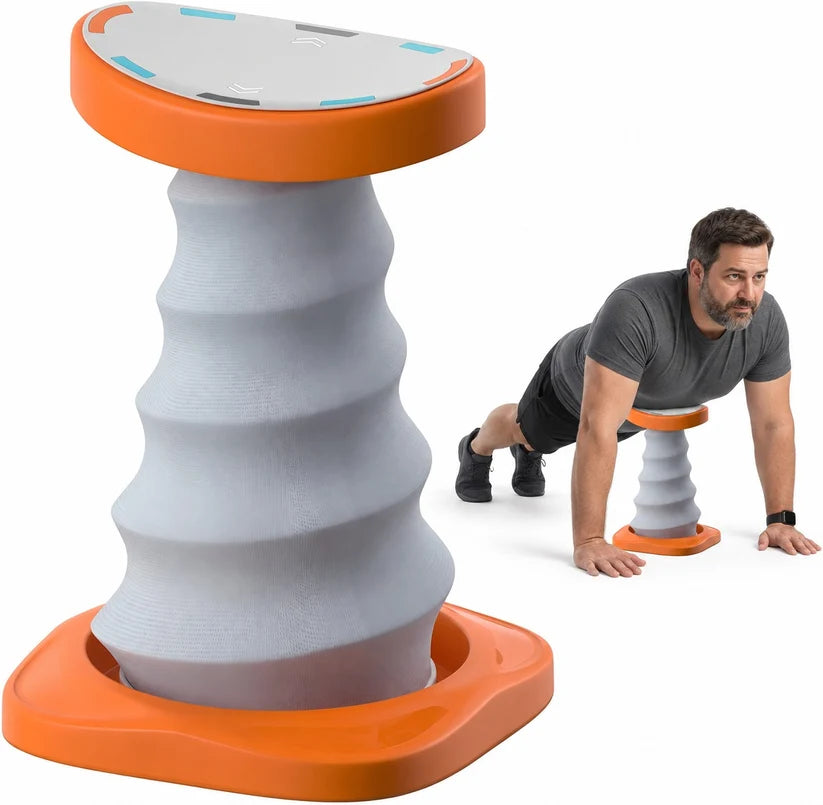
The spring column sits under your waist while you do a normal push-up — hands down, up on your toes, body straight. As you lower, it compresses and pushes back, taking approximately 30–70% of the load depending on your position. A spring pushes harder the more it's squeezed, so you get the most help at the bottom, where push-ups fail. The soft pad keeps your hips from sagging, less weight reaches your wrists, and the anti-slip base holds the floor. As you get stronger, shift your body so it helps less.

Your First Four Weeks, Rep by Rep
Week 1: push-ups still feel challenging — but now they feel possible, and you finish every rep. Week 2: your reps feel more controlled and pushing up from the floor feels familiar. Week 3: your upper body feels stronger and steadier; getting off the couch or out of the car may start to feel easier. Week 4: you're building real confidence moving your own body. Then you move through three stages — Assisted, Building, Independent — needing a little less help each time. Everyone starts somewhere different.

Built to Hold Real Bodies
Designed for users of approximately 88–550 lbs (40–250 kg). A high-strength spring column, a reinforced PP base that spreads the pressure, a soft cushioned pad, and a honeycomb anti-slip rubber underside that grips hardwood, tile, laminate and gym floors. No assembly and no tools — it's compact enough to live beside the bed. Every order includes free shipping and a 1-year warranty, and if it isn't right for you, you have a full 30 days to request a refund.
Loved by 10,000+ Happy Customers
-

I got down on the rug with my son and got back up without the sofa.
Last spring my 8-year-old asked for a push-up contest and I couldn't push my belly off the rug. I laughed it off and said my shoulder was sore. I'm 46 and around 260 lbs. I started with three sets of eight on this beside the bed every morning — on my toes, arms still shaking. By week four I'd moved further forward on the pad so it helped less. Last Saturday we wrestled on the living-room rug for twenty minutes, and I stood up without putting a hand on the sofa. He didn't notice. I did.
-

Nine months of knee press-ups, and I still couldn't do one on my toes.
I did knee press-ups three times a week for nine months, got up to 25, then tried one on my toes and went flat on the carpet. I'd bought a coloured press-up board too — it just moved my hands about. With this I'm on my toes from the start, and it takes enough weight near the floor that I can actually push back up. By week three I could feel my arms working instead of my lower back. In week seven I did two proper press-ups without it. Two. I rang my sister.
-

I thought it was cheating. My arms disagreed by rep six.
I'm 290 lbs and figured a spring would basically do the push-up for me. It doesn't. It takes some of the weight when I'm near the floor, which is exactly where I used to freeze — everything else is me. My chest and arms were sore for two days after the first session. A guy at work compared it to the assisted pull-up machine at the gym, and that's how I explain it now. It lives next to my desk, and I do a set between calls on work-from-home days. It hasn't shifted on my laminate floor once.
-

Fifty press-ups in the Army. Two at 58. Now my wife and I do them together.
On my 58th birthday I tried to show my grandson how we did press-ups in the Army. My arms buckled on the second one and my hips hit the floor, and at eighteen stone my wrists didn't thank me either. My wife bought the Couple Pack in January, half as a joke. Now we do three sets each on the kitchen tiles before the kettle boils. By about week six I'd shifted forward so the spring helps less, and the wrist ache had faded. I'm not 25 again, but for once I'm going the right way.


Real-Rep Assist™ vs. The Usual Workarounds
How a spring-assisted real push-up compares with knee push-ups, wall push-ups and push-up boards.
| Tebren | Others | |
|---|---|---|
| Keeps the real push-up on your toes | ||
| Takes part of your weight off | ||
| Most help at the bottom of each rep | ||
| Less pressure through wrists and shoulders | ||
| Clear steps from assisted to independent |
Try It Risk-Free For 30 Days.
30 Days Easy Return. We love our products and we're confident you will too! In case things don't go as planned, you have a full 30 days to request a refund.
FAQ
Will it hold my weight?
Will it hold my weight?
It's designed for users of approximately 88–550 lbs (40–250 kg), with a high-strength spring, a reinforced PP base and an anti-slip rubber underside. The spring compresses as you lower and pushes back as you rise. It's built to take part of your weight, not all of it, so your arms still do the pressing. Use it on a flat, dry floor with the column upright.
Isn't using a spring cheating? Will it build real strength?
Isn't using a spring cheating? Will it build real strength?
It's the same idea as the assisted pull-up machine at a gym. You do the real push-up — hands on the floor, up on your toes, body straight — with approximately 30–70% of the load taken off, depending on your body position. Your chest, shoulders, arms and core still do the work. As you get stronger, you shift your body so it helps less: Assisted, Building, then Independent.
How do I use it?
How do I use it?
There's nothing to assemble. Place it on a flat, dry floor — hardwood, tile, laminate or gym flooring. Get into a normal push-up position with your abdomen centred over the middle of the top pad, then move your body straight down and straight up, keeping the column vertical. Start with slow, controlled reps you can finish with good form.
Will it help if push-ups hurt my wrists or shoulders?
Will it help if push-ups hurt my wrists or shoulders?
With part of your weight on the spring, less of it goes down through your hands, so your wrists, elbows and shoulders carry less load on every rep. The pad also keeps your hips from sagging, which takes strain off your lower back. It isn't recommended for people with serious waist or joint injuries.
How quickly will I progress?
How quickly will I progress?
Week 1: push-ups still feel challenging, but now they feel possible. Week 2: your reps feel more controlled. Week 3: your upper body feels stronger and steadier, and getting off the couch or out of the car may start to feel easier. Week 4: you're building confidence moving your own body. From there you shift your position so the spring helps less. Everyone starts from a different place, so go at your own pace.
Who is it for — and who isn't it for?
Who is it for — and who isn't it for?
It's made for beginners, heavier bodies, people coming back after years off, and anyone stuck on knee or wall push-ups, training at home. It isn't recommended for children under 40 kg (88 lbs), pregnant users, people with serious waist or joint injuries, or anyone who can't keep basic balance during exercise. Every order comes with free shipping, a 1-year warranty and a 30-day easy return.